Breaking Through an Impasse: The Transformative Periods of Beethoven & Radiohead
- Oct 18, 2017
- 11 min read

The first time that I heard Kid A, Radiohead’s fourth studio album, I did not see it as such a departure from what the band had done before. This was back in my college DJ days. The station was sent a promo single for “Optimistic,” no doubt the most accessible song on the album. I was not engrossed in Radiohead enough at the time to recognize the transitory role of Kid A. It wasn’t until years later at a conference where I attended a presentation about Radiohead, that I took stock of their collective work. This would’ve been circa 2006, after Hail to the Thief, but before In Rainbows. Around that same time, I also remember being captivated while sitting in my romantic music lit class by the fact that a composer, in this case Beethoven, had what was described as a period of reflection.
I originally thought of Radiohead’s third album, OK Computer, as a “plateau” of sorts. But I now recognize that error. It implies a decline after, when really the albums that followed were a necessary departure that solidified them as one of the greatest bands of this generation. For Beethoven, a transition was also necessary, initially within himself. The struggles he faced in the later part of his life were naturally reflected in his music. In both cases, an evolution was needed in order to keep making music. On the heels of the 20th anniversary release of OK Computer, this is my attempt to compare the two transformative periods of Beethoven & Radiohead.
I realize that many artists that have had a long career have experienced similar creative blocks. This is a comparison of two artists that I personally know, listen to, and love.
Before the Impasse
So, Beethoven was deaf. Two things are important to note here: First of all, he was not born deaf. He continued to be a prolific composer even after his hearing loss. Secondly, his deafness was a gradual process that lasted about 25 years. He began to lose his hearing in 1796 at age 26, but was not completely deaf until about 1820, at age 50. The general consensus is that he had a long fight with the acceptance of his hearing loss.
Beethoven’s frame of mind at the point when he realized his hearing loss was incurable is distinctively captured in a letter he wrote to his brothers in 1802. This letter is known as the Heiligenstadt Testament. Found among his papers after his death, it affirms that his music saved him. Essentially, his music – the promise of it - saved him from complete despair.
Beethoven’s reflective and transformative period is generally classified as 1815-27. His works continued to be performed regularly, yet he retreated into himself. He had become increasingly meditative and abstract. This reached a high point once he became completely deaf. The works of this period include his last five piano sonatas, his last symphony, his mass “Missa Solemnis,”, and several incredibly complex string quartets. By contrast, his earlier works were more traditional and were mainly written for the piano. (a)
Beethoven straddles two periods of music history: the Classical and Romantic. (1) His music certainly reflects this. His crossover into the romantic period culminated with his focus on “externalization and realization.” (a)
The lead singer of Radiohead, Thom Yorke, was born with a paralyzed left eye and had five operations by the age of six. He had written his first song and joined his first band by age eleven. He described his school years as tolerable, mainly because the music department was set apart from the rest of the school. (b)
Yorke has explained that after OK Computer, the band felt pressure to imitate what they had already done. It reached a point where that caused the music to lose meaning for him. From his own words in 2013: “To begin with, writing songs was my way of dealing with shit. Early on it was all, 'Come inside my head and look at me', but that sort of thing doesn't seem appropriate now…By the time we were doing Kid A I didn't feel I was writing about myself at all. I was chopping up lines and pulling them out of a hat. They were emotional but they weren't anything to do with me.” (c)
The Impasse
On the verge of his transition period, Beethoven was grappling with artistic uncertainty. Being on the cusp between two developmental periods of music history, he was at a crossroads where traditions of the past were being reevaluated. He was faced with reinventing standard forms.
Beethoven was known to take long walks in the country, often to work out the details of his compositions in his head. An extension of this was respites he took in the countryside, as when he wrote the Heiligenstadt Testament in a village just outside of Vienna. He was able to convince himself that he needed to press on for the sake of his music. Not to mention he was an extremely determined guy. Beethoven’s music up to this point had already displayed a strong will and spirit. The many struggles he faced throughout his life, and his efforts to overcome them, are well documented. (2) It was in his last creative period that he moved beyond the personal tragedy of going deaf. He found an incredibly innovative path. He did this via a focus on refection, introspection, and contemplation.
After the completion of the OK Computer tour, in addition to feeling as if his music had lost meaning, Thom Yorke suffered a breakdown and subsequent depression. Being so focused for so long, and not having the time or inclination to reflect on it built up within him. It culminated in him becoming, in his own words, “completely unhinged.” (d) He felt a need to take more responsibility for what he was creating.
At that point, Yorke retreated to Cornwall, the extreme southwestern peninsula of England. His time was occupied by drawing in a sketchbook, and playing the only instrument he had access to: a Yamaha grand piano. Scaling back to the basics, the simplicity of both life and music, allowed him to break through: “I did that for a few months and I started to tune back into why I’d started doing it ... And the first thing I wrote was 'Everything in Its Right Place.’” (e)
Since then, Radiohead has focused on having more control over their music as a consumer product. This is exemplified by how they have marketed their albums post OK Computer. They leaked Kid A to Napster (3), and sold In Rainbows on-line for a name your own price basis. (f)

After the Impasse
Beethoven’s music of his late period reflects a more direct and intimate communication with humanity. His focus on unity and simplicity is displayed by his use of simple melodies and folk songs.
One (if not THE) most prominent characteristics of Beethoven’s late style is his way of treating the development of a composition. This was displayed by his extreme exploitation of a musical motive. (4) It was at this time that he perfected the art of making the most you could out of a motive or theme. He took one single idea or fragment and developed the heck out it. He did this to a certain extent by overlaying musical ideas and themes on each other and overlapping instruments. But mainly, he employed two musical concepts of the time that greatly catered to his focus on developing motives.
The first concept is the variation. Variation is a technique where material is repeated in an altered form. (5) In his late works, a theme is modified and stripped to its fundamentals, rather than simply varied. This is just one of the transformative methods employed by Beethoven at the time: an internal progression as opposed to reconciliation of divergent forces. (g) The focus on development and recycling musical material is so dominant and unyielding that it almost creates a trance-like feel in some of his late works.
The second concept is the fugue. A fugue is a composition or section of a composition developed during the Baroque period (ca. 1580-1730). In a fugue a subject is presented and then answered successively in various ways resulting in complex interwoven melodies. (6) It catered to the contemplative and complex style that Beethoven had adopted by this period. The focus on a concept from the past also spoke to his desire to give his music a universal quality. (h)
Rather than confine his music, Beethoven modified musical forms to suit his needs and what he wanted to express at this time. This is most apparent in his innovations to a standard form that had been used for many types of compositions: sonata form.
Beethoven expanded the development section of sonata form with more intensified utilization of the subject matter, and by introducing new themes. He disguised and varied the anticipated return of previous musical material. He expanded and lengthened the standard form. He either obscured or removed the traditional breaks between sections, to create a more fused, holistic composition. Yet he stayed true to the foundations of sonata form. The “presentation, development, and return” of musical ideas within a controlled framework remained integral to his artistic philosophy. (g)
The sense of obscurity that Beethoven created with some of his innovations to sonata form extended to other compositional devices he used at the time. He did not clearly define a tonal center or return to the same tonal center as expected in a composition. In addition to blurring the division between sections, he also did so between musical phrases.
His late string quartets, often considered his most external and transformative works, largely do away with structure or practical limits. This was at least somewhat due to technological advances at the time. For example, he utilized improvements to the violin family that allowed for an increased range and more advanced bowing techniques. (a) He also took full advantage of innovations to the piano, which had come about by 1800. Such innovations included a fuller tone, a wide dynamic range, orchestral effects, and dramatic expression. (h) In addition, he introduced new textures and sound color with inventive instrumentation. (a)
There was a delayed recognition of the influence of Beethoven’s late works, no doubt due to them being so intimate and challenging. His late works are considered too complex and personal to be imitated. His music had a crazy influence on all music thereafter. Specifically, his sonatas, symphonies, string quartets, violin concerto, and last piano concerto were considered models of achievement throughout the nineteenth century. (a)
Thom Yorke’s need to create new sounds potentially could have gone in many directions. But it resulted in the main characteristic of Radiohead’s post-OK Computer style: electronic music. He was drawn to it because it had no voices and emphasized structure, yet was still able to portray emotion. (d) A staple of Radiohead’s use of electronic music is using sampling and similar material as transitions.
Radiohead’s focus on electronic music resulted in a sense of obscurity that was not present in their earlier music. The later albums have masked lyrics and processed voice rather than the more straightforward, discernible rock vocals. All from different albums, “Kid A,” “Pulk / Pull Revolving Doors,” “Sit Down Stand Up,” and “Give Up the Ghost” have distorted lyrics.
Probably starting with OK Computer, I always thought of Radiohead as masters of layering elements, electronic or not. The electronic component just gave them a new array to exploit: trance-like repetition (“Packt Like Sardines in a Crushed Tin Box”), departing and converging elements (“Pyramid Song” & “Sail to the Moon”), layering variations (“15 Step”), building tension (“Present Tense” & “Sit Down Stand Up”), extreme development of fragments (“Daydreaming” & “True Love Waits”), and unexpected turns (“Bodysnachers”). I always thought of their music as being married to a classical tradition, of “Paranoid Android” as a mini-symphony. I guess I am not the only one, as many classical interpretations of their music have been done. (7) And wouldn’t you know it, lead guitarist / keyboardist Johnny Greenwood plays the viola, and has written orchestra parts for their songs as well as film scores.
Eventually, Radiohead’s use of electronic music began to morph with their past style. In Hail to the Thief there is more of a mix between electronic and rock elements, but the electronic seed had been planted. Though Kid A was initially shunned by some critics and fans, it ultimately allowed the band to press forward. It was a necessary means to redefine their sound and build a legacy.
“But what a humiliation for me when someone standing next to me heard a flute in the distance and I heard nothing, or someone heard a shepherd singing and again I heard nothing. Such incidents drove me almost to despair; a little more of that and I would have ended my life – it was only my art that held me back. Ah, it seemed impossible to leave the world until I had brought forth all that I felt was within me.” – Beethoven, Heiligenstadt Testament (j)

“When I was a kid, I always assumed that {fame} was gonna answer something – fill a gap. And it does the absolute opposite. It happens with everybody. I was so driven for so long, like a fucking animal, and then woke up one day and someone had given me a little gold plate for OK Computer and I couldn’t deal with it for ages.” – Thom Yorke (e)
Say What?
(1) Isn’t all of this type of music classical? Technically: No. Just like all dinosaurs are not from the Jurassic period, Classical is only one period of music history, and a short one at that. It has become a blanket term, for lack of a better one (art music, concert music, non-popular music) for music of the past that actually spans several periods.
(2) In addition to losing his hearing, Beethoven grappled with unrequited love and never married, antisocial tendencies (largely due to losing his hearing), reworking compositions, and a bitter feud with one of his brothers over the custody of his nephew.
(3) For millennials: Napster was the original peer-to-peer music file sharing service that was shut down for copyright infringement, and ultimately acquired by Rhapsody in 2011.
(4) A motive is a short musical fragment, or nugget, if you will. By contrast, a theme is longer and is considered the subject of a section or composition.
(5) The variations may be in harmony, rhythm, melody, texture, sound color, instrumentation or any combination of these.
(6) In Latin and Italian fugue means “flight,” and literally sounds like one: a subject is presented in the beginning and the rest of the composition unfolds via other subjects being varied and layered on the main subject, trying to catch up to it.
(7) Composer Steve Reich’s piece Radio Rewrite was inspired by two Radiohead songs; classical pianist Christopher O’Riley released a full album of Radiohead’s songs; the Vitamin String Quartet did a complete remake of OK Computer; Classic FM posted a detailed article giving examples as to how A Moon Shaped Pool is classical music. (i)
Giving Props:
(a) From the notes of my professor for all of my music lit classes in grad school: Dr. Schmidt, who has encyclopedic knowledge of all things music history
(b) Ross, Alex. “The Searchers: Radiohead’s unquiet revolution.” The New Yorker (21 Aug 2001) <https://web.archive.org/web/20070211155740/http://www.therestisnoise.com/2004/04/mahler_1.html>
(c) Adams, Tim. "Thom Yorke: 'If I can't enjoy this now, when do I start?” The Guardian. (21 Feb 2013) <https://www.theguardian.com/music/2013/feb/23/thom-yorke-radiohead-interview>
(d) Zoric, Lauren. “I think I’m meant to be dead…” The Gurdian. (22 Sep 2000) https://www.theguardian.com/friday_review/story/0,,371289,00.html
(e) Noakes, Tim. “Splitting Atoms with Thom Yorke.” Dazed. <http://www.dazeddigital.com/music/article/15601/1/splitting-atoms-thom-yorke>
(f) Blake, David K. “Technological Framas and Historical Narratives in Rock Music.”American Musicological Society <file:///C:/Users/kthurmond/Downloads/149-938-1-PB%20(1).pdf>
(g) Joseph Kerman, Alan Tyson (with Scott G. Burnham) “Beethoven, Ludwig van, sec. 16: Late-period style,” Grove Music Online (Accessed 09 February 2006)
(h) Donald J. Grout & Claude V. Palisca. A History of Western Music. 6th ed. New York: W.W. Norton & Company, Inc., 2001
(i) Clay, Dacia. “Radiohead: A Classical Shaped Band?” Houston Public Media <https://www.houstonpublicmedia.org/articles/arts-culture/2016/05/09/149652/radiohead-a-classical-shaped-band/>
(j) Solomon, Maynard. Beethoven. New York: Schirmer Trade Books, 1998.
Shows: Summer 2017



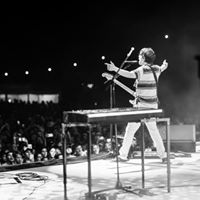


MGMT / Float Fest / San Marcos, TX/ July 23, 2017 / photo courtesy Float Fest Facebook page
Cage the Elephant / Float Fest / July 23, 2017 / photo courtesy Float Fest Facebook page
Weezer / Float Fest / San Marcos, TX / July 23. 2017 / photo courtesy Float Fest Facebook page
Austin Symphony Orchestra Concert in the Park / Austin, TX / August 6, 2017
Comments