The Italian Madrigal: The Cure Taps Into the Original Emo Music
- Jan 23, 2019
- 10 min read

I’ve always thought that the intense emotion expressed in the music of The Cure resembled that of Italian madrigals. It’s amazing how a band that broke out in the eighties channeled such such a sentiment from sixteenth-century Italian music, but this is just one of the things that makes The Cure such a diverse and fascinating band. It also provides a fresh look at the genre of the madrigal.
The Cure
The Cure appeared from the rubble of British punk. They formed in 1976 and were originally “The Easy Cure (a)” and / or “Malice (b).” They settled with The Cure in 1979 and this year celebrate their 40 year anniversary under that name. The stifled descriptions of their sound, including “gloom-rock,” “morbidly romantic (b),” and even “dirges,” instilled an image that distracted from the diversity of their music. (a) While a lot of bands probably fall victim to misrepresentation, I agree that such distortion especially affected The Cure. Their most well-known songs (“Boys Don’t Cry,” “Friday I’m in Love,” “Love Song”) don’t accurately represent their catalog. For me, they have become what I would call a “Mary Poppins” band, meaning that like Mary Poppins magic carpet bag, they keep producing music and seem to have a limitless well of songs (1). They seem to have an immense treasure chest of varied songs, and while most of them are not new, many of them are new discoveries to me. And the more I listen, the more I appreciate their music I have discovered.
The Cure has experienced a revolving door of band members in their four decades, but the one constant has been Robert Smith on guitar and vocals. The other two original members were Michael Dempsey on bass and Laurence “Lol” Tolhurst on drums. As of 2014 the band includes: Smith on guitar and vocals, Simon Gallup on bass, Jason Cooper on drums, Roger O’Donnell on keyboards, and Reeves Gabrels on guitar. (h)
They have presently the coveted position of being somewhat mainstream, but with a cult following. (b) The stability of the band has been tested over the years by drugs, over-emotional songs, and Smith’s collaborations with Siouxsie and the Banshees in the eighties. (b) These days they are mainly live act, performing multi-encores and chosen albums in their entirety.
The Madrigal
Madrigal is an Italian term meaning “song in the mother tongue.” It has presented itself in different forms throughout music history, but the one we are going to focus on is the Renaissance Italian madrigal. (2) This version was based on an Italian poem having any number of lines, each of seven or eleven syllables.
The madrigal was the most important genre of Italian secular music in the sixteenth century. Two thousand collections were published between 1520-1550. (c) They were mainly for four voices with one singer to a part, like vocal chamber music. Instruments often doubled or substituted for voices. Madrigals were sung in aristocratic and social circles, usually by amateurs, and eventually by performance groups, and in plays. (c) The sixteenth century Italian madrigal was often a polyphonic setting of the poem- that is, it was for more than one voice, each voice singing their own line simultaneously.
The king of the Italian madrigal was Claudio Monteverdi (1567-1643). He was born in Cremona and spent the majority of his long career as choirmaster at St. Mark’s church in Venice. His first five books of madrigals were published between 1587-1605 and were “monuments in the history of the polyphonic madrigal.” (c)
The Cure also had a very prolific period - producing nearly an album a year from 1979-1985. In their forty year tenure, they have proven they have tenacity and have managed to maintain their integrity.
Stylistic transitions
In the beginning, The Cure’s sound was “jagged edgy pop songs.” Yet by the mid-eighties they had moved away from being the founders of “goth-rock” and became more mainstream. (a) Their sound became much bigger, border-line symphonic, utilizing layers of guitars and synthesizers.
Monteverdi had a large part in making the concerto version of the madrigal popular. The concerto medium included instruments and wrote separate parts for voices and instruments. This was a major stylistic transition on his part, as he moved the genre of the madrigal away from being strictly a polyphonic vocal ensemble to an instrumental accompanied solo or duet. (c) Monteverdi’s style in general hinged upon employing a variety of diverse elements, including a varied texture via the concerto medium.

Emo music
Fitting with a band that was apt to experimenting with and expanding their sound, The Cure’s songs represent a diverse range of moods and subjects. While resting heavily on the ecstatic, first throws of infatuation (“Why Can’t I Be You,” “Just Like Heaven”) and bitter heartbreak (“Disintegration”), their songs seem to cover all the stages of a relationship: longing (“One More Time,” “Want”), lust (“Let’s Go to Bed”), reflection (“Pictures of You,” “In Between Days”) and acceptance (“Cut Here”). They also touch upon pastoral subjects (“A Forest”) and wonders of the world (“The Hanging Garden”). They range from playful (“Lovecats,” “Close to Me”) to angry (“The Kiss,” “Give Me It”). Smith notes they are the only band “rationally perceived as both suicidal and whimsical.” (b)
The rise of the madrigal in the sixteenth century was definitely connected with the taste in Italian poetry, particularly a revival of the poetry of Petrarch (1304-74). Like Cure songs, Petrarch’s poetry focused on two opposing qualities: pleasingness and severity. “Pleasing” was represented by grace, charm, and playfulness and “severity” by dignity majesty, and grandeur. Elements such as rhythm, the distance between rhymes, and the patterns of accents distinguished pleasing and severe sounds. (c)
Madrigals were characteristically sentimental, erotic, or pastoral and usually had a clever or amusing ending. Smith has stated that The Cure’s music has always reflected is mental state. (b) Below is the translated text for Monteverdi’s madrigal Ohimè dov’è il mio ben. (d) It is from his seventh book of madrigals and is a romanesca for two sopranos. (4)
Alas! Where is my beloved, where is my heart?
Who has concealed my love and taken her away?
Can it be that love of honour
should bring me such grief?
Can it be that ambition and vainglory
have prevailed more than love?
Alas, foolish, blind world! Alas, cruel fate
that has made me minister of my own death!
Compare this to the lyrics for The Cure’s song “A Thousand Hours” from Kiss Me, Kiss Me, Kiss Me, (e) where Smith’s anguished, almost wailing voice soars above lush synthesizers ornamented with delicate piano motives:
For how much longer can I howl into this wind?
For how much longer
Can I cry like this?
A thousand wasted hours a day
Just to feel my heart for a second
A thousand hours just thrown away
Just to feel my heart for a second
For how much longer can I howl into this wind?
Such intense emotion often took a morbid turn in both madrigals and Cure songs. Below is the translation for Monteverdi’s madrigal Sì ch’io Vorrei Morire, from his fourth book of madrigals with a poem by Maurizio Moro (f):
Yes, I would like to die,
now that I kiss, Love,
the beautiful mouth of my beloved.
Ah, dear and sweet tongue,
give me such a feeling
that from sweetness I expire on this breast!
Ah, my life, on this white bosom,
oh, press me until I swoon! Ah, mouth, ah, kisses, ah, tongue, I say again:
Yes, I would like to die
Compare this to The Cure’s “The Kiss,” also from Kiss Me, Kiss Me, Kiss Me. (g) A guitar heavy foundation builds for nearly four minutes until Smith’s voice comes in with a screaming vocal style that continues throughout the song.
Kiss me kiss me kiss me
Your tongue is like poison
So swollen it fills up my mouth
Love me love me love me
You nail me to the floor
And push my guts all inside out
Get it out get it out get it out
Get your fucking voice
Out of my head
I never wanted this
I never wanted any of this I wish you were dead
I wish you were dead I never wanted any of this I wish you were dead Dead
Dead
Dead
Stylistic similarities
Above all, madrigal composers aimed to take advantage of the pictorial qualities of the text and the expressive qualities of the music. In order to do so, madrigals broke away from fixed song forms. They did not rely on refrains or patterned repetitions, but rather came to be through-composed, and included new music for each stanza of the poem. (c) In the same vein, Cure songs certainly do not follow a traditional pop song or verse-chorus form.
In additional to taking advantage of combining different types of textures as a means of expression, madrigalists aimed to create a true reflection of the text of the poem. (c) Conveying the poem’s ideas, images, and passion was paramount.
The Cure’s songs present that same specific inclination, often inserting calculated instrumentation to express or contradict the established mood of the song. But by far, their most expressive instrument is Smith’s voice. His variety of vocal styles - speech-like in “Meathook,” distant in “A Forest,” and imitative sounds in “Lovecats” - dutifully serve the text and perfectly emulate the mood of each song.
Madrigals did not shy away from having exclamatory vocals. Smith employs an exclamatory vocal style in songs such as “Give Me It” and “The Kiss.” Even further, “Want” and “Disintegration” include what may be called a vocal rant as a dramatic culmination. By the same measure, madrigalists favored the sonnet form because it did not have internal repetition and progressed toward a climax and resolution. (c)
In the sixteenth century madrigal, ornaments were often written in rather than improvised by the singer. (c) Again, Robert Smith often incorporates sounds and embellishments into his vocals. For example, in “Six Different Ways” the music and vocals imitate each other.
In a concerto madrigal, the instruments and voices are equal. The instrumental participation was largely due to Monteverdi’s style in his 5th-8th books of madrigals (1605-38), which included basso continuo, instrumental solos, duets, trios, instrumental introductions. (c) I would say that in the same way, TC makes the music as important as the lyrics. Not only is this evidenced in the specific way they utilize instruments and their instrumental experimentation over the years, but many of their songs have long instrumental introductions. To name just a few examples: “Plainsong” comes in at 2:38, (5) “Want” at 2:20, and “The Kiss” at a whopping 3:50. I often relied on these instrumental introductions when I was a college DJ as background music while I announced a playlist.
Controversy
Monteverdi’s madrigal Cruda Amarilli sparked a controversy. The way Monteverdi combined the voices in the polyphonic texture was criticized in a dialogue by Giovanni Maria Artusi called Imperfections of Modern Music. (1600) (c) Artusi’s beef was influenced by Gioseffo Zarlino - a major player in the movement in the 1540’s toward emotional expression in music.
Zarlino wrote a book called The Harmonic Foundations that was instruction on writing polyphonic music and had strict rules for dissonances. (6) They took this seriously, and Artusi felt that Monteverdi broke these rules.
Cruda Amarilli was accused of having “grating dissonances.” (c) Monteverdi argued that he included such dissonance purposefully to convey the feeling of the poet’s message through the music. He defended himself in a credo he included in his fifth book of madrigals. He saw the bigger picture, and basically said, “Look, we’ve inherited a variety of styles, let’s make a distinction between two: the first and second practices.”
The first practice, also called prima pratica, was the older style of vocal polyphony codified by Zarlino where the music dominated the text. The second practice, or secunda pratica, was the more modern and adventurous style of Cipriano de Rore (1515-65), Luca Marenzio (1553-99) and Monteverdi. The text dominated the music. It was okay to break the old rules and use dissonances more freely to express feelings in the text. (c) (7)
The Cure also experienced controversy and felt a need to distinguish their music. Their debut single “Killing an Arab,” based on Albert Camus “The Stranger,” prompted them to provide an explanation to the press. (b) Although clearly doing their own thing, The Cure were often compared to Duran Duran and Morrissy. Robert Smith has stated that the release of Wish in 1992 was characterized by their struggle to be both successful and honest. Much like Monteverdi felt a need to define the first and second practices, Smith wanted to separate The Cure from Brit pop. He has stated he is “more comfortable with being slightly outside of what was going on.” (b)

Say What
(1) Other “Mary Poppins” bands for me include Radiohead and The National
(2) Fourteenth century Italian verse form and it’s musical setting, have two or three stanzas followed by a ritornello
(3) Secular = non-religious, as opposed to sacred = religious
(4) A romanesca is an air for singing ottave rime (poems with a stanza of eight of eleven syllable lines the eighth rhyming with the seventh); it is a treble formula with a standard harmonization of bass. (c)
(5) Think Kirsten Dunst as Marie Antoinette descending the steps at Versailles
(6) Dissonance is a lack of harmony among notes, as opposed to consonance, which is harmonic agreement among notes
(7) The first and second practice was also referred to as stile antico and stile moderno (old and modern style). (c)
Giving Props
(a)All Music, The Cure biography by Stephen Thomas Erlewine:
https://www.allmusic.com/artist/the-cure-mn0000137390/biography
(b)The Guardian: “The Cure’s Robert Smith: I Was Very Optimistic When I Was Young - Now I’m the Opposite” by Dorian Lynskey: https://www.theguardian.com/music/2018/jun/07/the-cures-robert-smith-i-was-very-optimistic-when-i-was-young-now-im-the-opposite
(c)Donald J. Grout & Claude V. Palisca. A History of Western Music. 6th ed. New York: W.W. Norton & Company, Inc., 2001
(d) Wikipedia, Ohimè dove il mio ben:
http://www2.cpdl.org/wiki/index.php/Ohim%C3%A8_dove_il_mio_ben
(e)Songwriters: Boris Williams / Laurence Andrew Tolhurst / Porl Thompson / Robert James Smith / Simon Gallup A Thousand Hours lyrics © Universal Music Publishing Group
(f) Williams Chamber Choir, Monteverdi Madrigals, Texts and Translations:
https://music.williams.edu/files/2010/01/040811_texts__translations_-_Monteverdi.pdf
(g) Songwriters: Robert James Smith / Laurence Andrew Tolhurst / Simon Gallup / Porl Thompson / Boris Williams The Kiss lyrics © Sony/ATV Music Publishing LLC, Peermusic Publishing, Universal Music Publishing Group
(h) The Cure, official site, biography: http://www.thecure.com/bio/
Shows Fall 2018


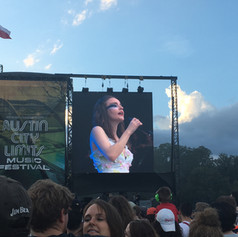



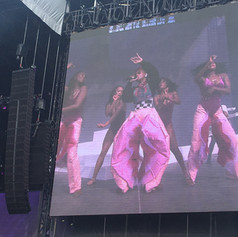

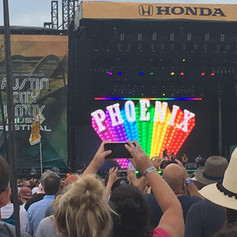



Foxing / Austin, TX / September 12, 2018
Jade Bird / Austin, TX / September 19, 2018
Lord Huron / Austin, TX / September 29, 2018
Alvvays / Austin City Limits Festival / October 5, 2018
Paul McCartney / Austin City Limits Festival / October 5, 2018
Brandi Carlile / Austin City Limits Festival / October 6, 2018
CHVRCHES / Austin City Limits Festival / October 6, 2018
Twin Shadow / Austin City Limits Festival / October 7, 2018
Janelle Monae / Austin City Limits Festival / October 7, 2018
Phoenix / Austin City Limits Festival / October 7, 2018
The National / Austin, TX / October 11, 2018
David Byrne / Austin City Limits Festival / October 12, 2018
The National with Lauren Mayberry of CHVRCHES / Austin City Limits Festival / October 12, 2018
Maggie Rogers / Austin, TX / October 23, 2018
University of Texas New Music Ensemble: The Yellow Wallpaper / Austin, TX / December 5, 2018
University of Texas Holiday Choral Concert / Austin, TX / December 10, 2018
Comments