The Classical Adagio: The Original Slow Jam
- Jun 3, 2019
- 13 min read

Usually when I am listening to a multi-movement instrumental work, the second movement catches my ear. Being a card-carrying introvert, I am drawn to the mood of reflection and contemplation that the second movement often provides. In the same manner, I feel that the slower songs of well-known artists from my adolescence, the so called “slow jams,” are the songs that still hold water for me and will inspire a belt-out session (while driving alone, of course). Here I am going to examine the similarities between the slow movements of instrumental compositions and slow jams.
First of all, let’s go back to eighth grade music appreciation class, and discuss the basis of tempo - how fast the music should be played. The slow movement is referred to as such because its tempo is slowest out of all the movements in the piece. Below is a very basic spectrum of tempos, named in Italian. (1)
Largo - very slow, broad
Grave - very slow, solemn
Adagio - slow
Andante - moderately slow, a walking pace
Moderato - moderate
Allegro - fast
Vivace - lively
Presto - very fast
Prestissimo - as fast as possible
Of course what is listed here may be considered as the bare bones of a house without all the upgrades - this was or became way too basic for some composers. They often provided additional description to the tempo to get their desired effect - the most common being Molto (much) and Non troppo (not too much). Beethoven marked the second movement of his String Quartet in F Major, Op. 18, No. 1 as Adagio affettuoso ed appassionato (very slow, tender, and impassioned).
Later, Gustav Mahler took it further, adding score markings to reflect many aspects of the music, in German. A few examples of the many directions he included for his nine symphonies that relate to tempo are: etwas drängend(er) (somewhat (more) pressing forward), getragen (solemn, measured), im Tempo nachgeben, im Tempo nachlassen (relaxing into the tempo), and sehr langsam und stetig bis zur höchsten Kraft anschwellend (very slowly and steadily swelling to highest strength). (a)
Classical Instrumental Compositions
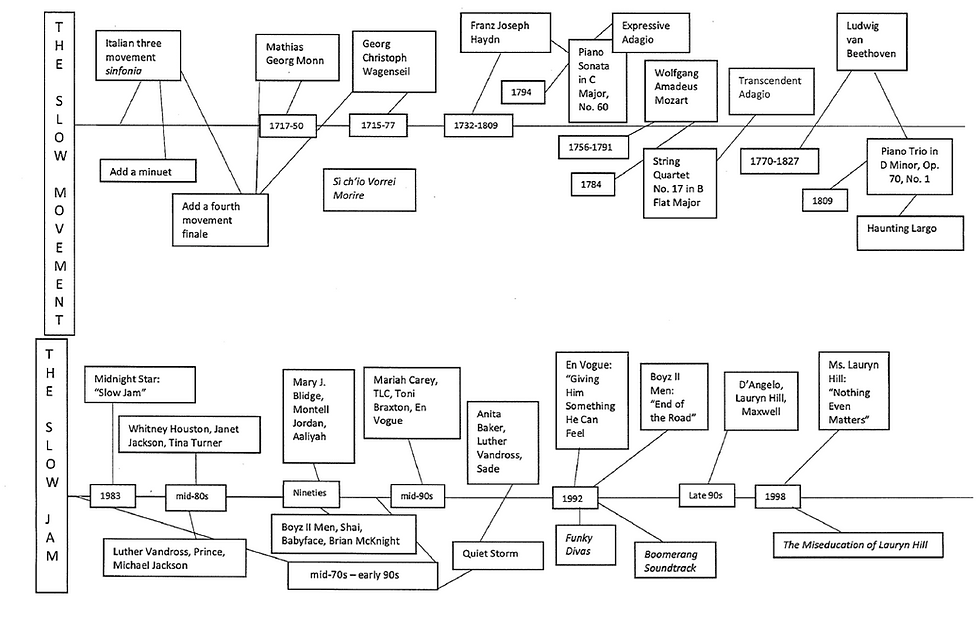
When looking at the origins of the symphony of the Classical era, the Italian three-movement sinfonia, following the tempos fast-slow-fast, dominated in Europe. Mozart crafted some three movement symphonies to adhere to the Italian practice, but added a minuet - a dance movement - to them later to fit in with the Austria & Germany style. (b) (2) Remember, the classical era was a cosmopolitan time, where cultures were intermingled. Composers often reacted to the tastes of their geographic location.
Hence, a three-movement symphony gradually became four movements. However, it is too simple to say that the Classical symphony evolved from the Italian sinfonia with a minuet added. In many early Classic works the third movement is a minuet, therefore, it is more likely the fourth movement finale is the real addition. (b)
Indeed, in Austria, the symphonies of Mathias Georg Monn (1717-50) and Georg Christoph Wagenseil (1715-77) included a minuet as the third of four movements (b). Monn’s Symphony in D (1740) resembled an instrumental suite of the previous Baroque era, in that all of the movements were in the same key, and the second movement is an aria, or song-like. (3) This brought us closer to the multi-movement structure that was solidified in Classical symphonies and other instrumental works.
Instrumental compositions of the Classical era are usually four movements of contrasting tempo & character. A common tempo structure for four-movement works came to be: fast-slow-dance-fast. The Classical symphony & string quartet are usually four movements, as well as the piano trio, sonata, and some concertos.
Slow movements tend to be in the Largo - Andante tempo range. It characterizes broad, song-like melodies. It usually has a lyrical mood, and does not focus on developing a theme, as the first and last movements do. (c) The first and last movements of instrumental Classical works are usually in the tonic key, which is the foundation of the entire piece. For contrast, the slow movement is usually not in the tonic key.
As far as musical form, the slow movement is generally in A-B-A / three-part form, theme & variations form, or a modified sonata form that omits the development section. (4) The slow tempo makes a theme more difficult to develop, and a graceful melody does not adapt well to the fragmentation characteristic to a development section. (d)
When looking at a piece as a whole, the role of the slow movement is to provide contrast. It is an opportunity to “present the purely lyrical aspect of the musical art.” (c) Here we are going to focus on the slow movements in three works of the Classical giants: Haydn, Mozart, and Beethoven (who has one foot in the following Romantic era).
Haydn, Piano Sonata in C Major, Hob. XVI/50, No. 60 (1794)
A Haydn keyboard sonata from 1794 would have the option of being performed on the “pianoforte,” while earlier sonatas could only be written for the harpsichord. The “modern” pianoforte was more capable of expressive dynamics. Therefore, the time period in Haydn’s long career of this particular keyboard sonata gave him a novel outlet for expression. His late sonatas show how much he was in touch with musical fashions. (e) Most of Haydn’s piano sonatas were written for students, but this one was for Therese Jansen, a well-known pianist. It was one of his last three piano sonatas that he wrote on his second visit to London in 1794-95. (f)
It is in three movements:
Allegro
Adagio (in F major)
Allegro molto
There seems to be some discrepancy about the form of the Adagio movement. It has been called sonata form with a brief development section (g), as well as a “quasi-improvisatory rhapsodic meditation.” (h). I am going to settle on the compromise that it is in A-B-A / three-part form. It is in the key of F Major, so it does adhere to contrasting the tonic key of the other movements. It is apparent this Adagio movement was not written for an amateur because of its expressive and technical demand. (g)
It utilizes the classic Italian cantabile, song-like style. It wraps a simple melody around beautiful embellishments. This movement has been referred to as “poetically embellished,” like the later Classical piano trios set for an ensemble of three instruments. (h)
It is clear from the beginning that Haydn is not only exploiting the solo piano, but the capabilities of the piano at the time. The theme seems to set the stage and then say, “Let me explain further, go deeper.” Indeed, the second part includes several modulations and a pedal point. (i) (5) The overall mood is calm satisfaction and carefully-crafted reflection, but Haydn does pepper in harmonic surprises and sparks. (f) The piano dances around trill-like figures, then then scales back, as if it is pouring out its heart. As we have said, the main function of the slow movement is to contrast, and this Adagio in particular does so to the finale, which quintessentially displays Haydn’s humor and unpredictability. (h)
Mozart, String Quartet No. 17 in B Flat Major, K. 458 (The Hunt) (1784)
Mozart’s string quartets No.s 14-19 are dedicated to Haydn, a colleague of Mozart's and the main craftsman of the Classical string quartet. This is the fourth of six string quartets Mozart composed between 1782 and 1785. It is nicknamed The Hunt because of the hunting call that begins the quartet.
It is in four movements:
Allegro vivace assai
Menuetto and Trio. Moderato
Adagio (in E Flat major)
Allegro assai
Notice here Mozart changes it up - instead of making the Adagio the second movement and the Minuet the third, he pulls a switch-a-roo. This just goes to show how nothing in musical structure is set in stone, and is just one example of how creative Mozart in particular was within specific “confinements.”
The Adagio “moves onto a different plane.” (j) It is in sonata form without a development. The beginning of the movement circles around the relative minor key. A legato, embellished theme in the violin is followed by an exquisite conversation between the violin and cello. (k) An exchange between the first violin and the cello concludes the first theme. The melancholy second theme begins in the first violin and then is handed over to the cello. The other instruments provide a pulsating accompaniment. (l) The chromatic lines and the omission of beginning measures in the recap section heightens the tension and asymmetry. (m)
The alternating dynamic markings represent the transitions thoughts can take. The suspensions and prolonged notes display how people can second guess themselves. Towards the end of the movement, it is as if the melody is reaching toward a light, representing how humans strive for clarity. Overall, the movement lacks thematic contrast and transitions and portrays a transcendent quality.
Beethoven, Piano Trio in D Major, Op. 70, No. 1 (Ghost) (1809)
This is the first of the two piano trios Beethoven wrote while he was lodging at the residence of Countess Marie von Erdödy; he dedicated both of them to her. It was first performed at her home with Beethoven at the piano. (n) The trio is thought to come out of plans Beethoven had for music for the witches' scene in an opera based on Shakespeare's Macbeth, which never came to fruition. Hence it’s ghostly character. It is from his epic middle period, which is abundant with chamber music.
It is in three movements:
Allegro vivace e con brio
Largo assai ed espressivo (in D minor)
Presto
The tempo Largo assai ed espressivo translates to “rather slow & stately and very expressive.” Beethoven found a novel, focused approach to using the fast-slow-fast movement structure. It is in A-B-A / Three-part form with a coda, and in the parallel minor key of D Minor.
From the get-go, Beethoven sets a supernatural mood. It is in fact this movement that gives the piano trio is nickname ”Ghost.” Again, as the slow movement is wont to do, it provides a sharp contrast to the lively movements surrounding it. It has been deemed “the slowest slow movement in all of Beethoven, and the most impressionistic.” (n)
The Largo displays a fragmented theme and utilizes innovative orchestration for the three instruments. The unstable harmony, sudden changes, and trembling in low register of the piano supplement the mood, and build tension and dread. The way the melody is passed around and the exploitation of dynamic changes create a feeling of longing. The slow movement is actually the longest movement. It “is the work’s focus and center of gravity.” (n) It is one of many Beethoven compositions that paved the way for Romantic composers in the next era.

Slow Jams
Slow jams are R&B ballads with a soul influence. They are down-tempo, tender and have strong emotional or romantic lyrics. The term came to use when Midnight Star recorded “Slow Jam” on their album No Parking on the Dance Floor (1983). (p) The blues component of R&B explains the emotional content of slow jams. R&B also has its origin in church music, which encouraged expressing very personal experiences. Since the eighties, R&B has gone through incarnations due to the influence of different styles, such as soul, funk, pop, and hip-hop.
The mid-eighties was dominated by artists such as Luther Vandross, early Prince, Michael Jackson, Whitney Houston, Janet Jackson, and Tina Turner. In the late eighties, producer Teddy Riley made records heavily influenced by hip-hop. This was deemed the new jack swing style, and was exemplified by Keith Sweat, Jodeci, and BellBivDeVoe.
In the nineties, producers Jimmy Jam and Terry Lewis and producer-artist Babyface specialized in the lush ballads of Boyz II Men, Shai, Babyface, and Brian McKnight. Producer Sean “Puffy” Combs also ushered in the hip hop soul style of artists such as Mary J. Blidge, R. Kelly, Montell Jordan, and Aaliyah. The R&B style of the mid-nineties is characterized by Mariah Carey, TLC, Toni Braxton, and En Vogue; the late nineties by D’Angelo, Lauryn Hill, and Maxwell. (p)
Yet another shift in R&B happened with the quiet storm format, popular from the mid-seventies to the early nineties. It was a radio format created by Melvin Lindsey and Jack Shuler at Howard University that gained national popularity. (q) Quiet storm songs steered clear of political and social issues. It’s style was smooth above all things and focused on sensual subjects. The format combined R&B soul and slow jams with songs with similar characteristics from the same and previous era. It was exemplified by artists such as Anita Baker, Luther Vandross, and Sade. (r)
Because R&B has undergone so many incarnations, there is debate over what is considered slow jam. For this purpose, for me, the contrast is important. Just like the slow movement of a multi-movement instrumental piece contrasts with the other movements, a slow jam contrasts with the other songs on the album. The subject matter is love: beginning, maintaining, and ending. Of course, my inclination is to songs from my generation.
En Vogue, “Giving Him Something He Can Feel,” Funky Divas (1992)
“Giving Him Something He Can Feel” was on the album Funky Divas, which managed to move R&B in to the pop realm in the nineties. My middle school group of friend & I were enthralled by it. An incredibly diverse album, “Giving Him Something He Can Feel” is the stand out slow jam amongst tracks such as the female power-driven “My Lovin’ (You’re Never Gonna Get It)” and the rock-infused “Free Your Mind.”
It is a remake of the song “Something He Can Feel” from the 1976 film Sparkle, performed by Aretha Franklin on the soundtrack. (s) True to the quiet storm format, “Giving Him Something He Can Feel” is a throwback to the female groups of the sixties. This is apparent in the dazzling vocals and the video that depicts the members all glammed up in a nightclub performance. Dawn takes the lead throughout the entire song, even providing a sultry spoken interlude. To me, the song is about maintaining the infatuation a woman has for a man, and celebrating intense passion.
“End of the Road,” Boyz II Men, Boomerang Soundtrack, Cooleyhighharmony (re-release) (1992)
“End of the Road” has good company on the Boomerang soundtrack, including P.M. Dawn’s “I’d Die Without You,” and Toni Braxton’s “Love Shoulda Brought you Home.” As Stephen Thomas Erlewine put it, the soundtrack is “actually better than the film itself.” (t) The song was produced by L.A. Reid and Babyface, who also wrote it along with Daryl Simmons specifically for Boomerang. Due on the road the next day, legend has it Boyz II Men recorded their vocals in three hours. (u)
“End of the Road” is ranked at number fifty-five on Billboard's All Time Top 100 Songs. It is definitely in my top five break-up songs. It sets the tone with a spoken intro by prob the deepest bass ever, Michael McCary. The group dynamic adds layers to the song, as all of the members have solo parts. This gives you options for singing along - I rock the Wanya part myself. Yet all the voices display the same foundation of heartbreak. It has the quintessential nineties R&B bridge passage, with Michael coming in again with a spoken section. This time he uses authentic poetry to spill his heart out. The song has a perfect ending: a capella and showcases the group’s stellar harmony.
Ms. Lauryn Hill, “Nothing Even Matters,” The Miseducation of Lauryn Hill (1998)
First of all, this album is timeless, crowd-pleasing, and exquisite. It’s quality has been re-recognized in the past year due to its twentieth anniversary. As Touré put it, “I could put that album on, right now, and my mom, my kids, and my wife, and I would all be happy.” (v)
“Nothing Even Matters” is Track 14, towards the end of the album. Not the only slow jam - it’s sentiment resembles that of “Ex-Factor,” “When It Hurts So Bad,” and “To Zion.” However, it is the only song on the album that portrays the bliss of being in love. It is sandwiched between “Every Ghetto, Every City” and “Everything is Everything,” two songs that portray a social and cultural message.
The opening bars of the song firmly establish its delicate and soulful nature. The sparse texture and heavy bass allow the voices to take center stage. “Nothing Even Matters” is a duet between Lauryn and D’Angelo, who pretty much defined sultry. The voices and the instrumentation couldn’t be smoother. The two voices hand off poignant lyrics of mutual affection. They cover the spectrum of things that “don’t matter” - from manicures to natural disasters. But far from portraying apathy, I always felt that “Nothing Even Matters” is about how two people are so enveloped in each other that everything else seems trivial. We all long for that feeling, however brief it may be.
Of course, many different types of music provide a catalyst to self-reflection. But I feel that the slow movement in particular provides the space for immersion, while the slow jam allows us to hone in on those emotions we have felt, or long to feel. They have the courage to be quiet, still, and vulnerable.
It was so hard to choose these examples! Honorable mentions include:
Haydn, Piano Trio No. 44 in E Major, Hob. XV, No. 28
Haydn, Symphony No. 88
Mozart, Violin Concerto No. 1 in B Flat Major, K. 207
Beethoven, Violin Sonata No. 2 in A Major, Op. 12, No. 2
Beethoven, Piano Trio in E Flat Major, Op. 1, No. 1
Sade - "No Ordinary Love"
SWV - "Weak"
Janet Jackson - "Again"
Usher - "You Got It Bad"
Mary J. Blidge - "Be Without You"
Click here for the graphic conclusion
Say What?:
(1)There are additional tempos that could be included as degrees on this spectrum, including Andantino (slightly faster than Andante), Allegretto (moderately fast) and Vivacissimo (very fast and lively).
(2) A minuet is a dance in triple meter usually followed by a second minuet called a Trio, after which the first minuet returns.
(3) An aria is a tune or formula for singing poetry; a strophic song; or a songful monologue or duet in an opera or other vocal work.
(4)The typical sections of a sonata form movement include the exposition, development, and the recapitulation.
(5) A pedal point is a note sustained in one part (usually the bass) through successive harmonies, some of which are independent of it.
Giving Props:
(a)Glossary of Terminology for Mahler Symphonies: http://www.orchestralibrary.com/reftables/mahler2gloss.html
(b)Pauly, Reinhard G. Music in the Classic Period. 4th ed. Upper Saddle River: Prentice Hall, 2000.
(c)Machlis, Joseph, with Kristine Forney. The Enjoyment of Music. 6th ed. New York: W.W. Norton & Company, Inc., 1990.
(d)Hoffer, Charles R. The Understanding of Music, Belmont: Wadswoth Publishing Company, Inc., 1967.
(e)Donald J. Grout & Claude V. Palisca. A History of Western Music. 6th ed. New York: W.W. Norton & Company, Inc., 2001.
(f) Vancouver Recital Society Program Notes: Sir Andreas Schiff: https://vanrecital.com/2015/02/program-notes-sir-andras-schiff/
(g)All Music, Jon Palmer: https://www.allmusic.com/composition/keyboard-sonata-in-c-major-h-16-50-mc0002365306
(h)Hyperion Records: https://www.hyperion-records.co.uk/dw.asp?dc=W9646_67554
(i)Tonic Chord: https://tonic-chord.com/haydn-piano-sonata-in-c-major-hob-xvi50-analysis/
(j)https://www.hyperion-records.co.uk/dw.asp?dc=W9187_66234
(k)All Music, Brian Robins: https://www.allmusic.com/composition/string-quartet-no-17-in-b-flat-major-hunt-k-458-mc0002370172
(l) The Teaching Company, The Chamber Music of Mozart, Professor Robert Greenberg:
http://www.stonedcoder.org/~aestetix/chamber/Chamber%20Music%20of%20Mozart.PDF
(m) Coaching Mozart's Quartets K. 458, K. 464, and K. 465: Techniques for a Beginning College Strong Quartet Laurel Sung Yu: https://diginole.lib.fsu.edu/islandora/object/fsu:185193/datastream/PDF/view
(n) Solomon, Maynard. Beethoven, New York: Schirmer, 1998.
(o)Hyperion Records, Richard Wigmore: https://www.hyperion-records.co.uk/dw.asp?dc=W4074_67327
(p) Ward, Ed, Encyclopedia Britannica, “Rhythm and Blues,” https://www.britannica.com/art/rhythm-and-blues
(q) Beamon, Todd, “Durable Radio Format Survives Shift in Tastes,” https://www.nytimes.com/1987/02/19/arts/durable-radio-format-survives-shift-in-tastes.html
(r)Harvey, Eric, “The Quiet Storm,” https://pitchfork.com/features/underscore/8822-the-quiet-storm/
(s)All Music, Jose F. Promis: https://www.allmusic.com/album/funky-divas-mw0000082287
(t)All Music, Stephen Thomas Erlewine: https://www.allmusic.com/album/boomerang-original-soundtrack-mw0000077760
(u)U Discover Music, Paul Sexton: https://www.udiscovermusic.com/stories/end-of-road-begins-boyz-ii-men/
(v) Touré, “Writers Reflect on Ms. Lauryn Hill’s ‘The Miseducation of Lauryn Hill,” http://read.tidal.com/article/ms-lauryn-hill-miseducation-20-years-writers
Shows Spring 2019












"Waitress" / January 23, 2019 / Austin, TX
"Anastasia" / February 13, 2019 / Austin, TX
Gin Blossoms / March 7, 2019 / Austin, TX
Valley Maker / March 14, 2019 / Austin, TX
Valley Maker / March 15, 2019 / Dallas, TX
"Fiddler on the Roof" / April 3, 2019 / Austin, TX
"Cats" / May 8, 2019 / Austin, TX
Dave Matthews Band / May 17, 2019 / The Woodlands, TX
Dave Matthews Band / May 18, 2019 / Dallas, TX
"Hamilton" / May 23, 2019 / Austin, TX
Comments