Great Expectations: When Live Music Goes Wrong
- Sep 30, 2021
- 14 min read

As soon as I heard about the documentary Woodstock ‘99: Peace, Love, and Rage, I put it on my watchlist...but I knew it would sit there for a little while. I couldn’t watch it right away because I was certain it would make me feel crummy about my generation.
Although it occurred at the onset of my legal adulthood, my knowledge of this ill-fated festival was limited. I knew about the fires and the riots on the last night, but little beyond that. Still, due to a kind of despicable sixth sense, a deplorable foreboding that possibly only those that grew up in the 90’s can understand -- I knew it would upset me, and I wasn’t looking forward to the icky feeling I was sure it would produce.
Boy was I right. But I miscalculated how upset it would make me. I carried it for days afterward -- it lingered, like a rampant case of B.O. And I think I can say I’m not the only one. The Atlantic reported that the documentary “confirms [the public image of the festival’s] veracity in disgusting detail.” (a) Marc Hogan points out that it is the opposite of Summer of Soul -- a documentary about the Harlem Cultural Festival in 1969 that also just came out. (b)
Because I function via overanalysis, I wanted to pinpoint why this was the case -- why was I so upset about this? Thus led to unpacking my personal early live music experience, and the reactions of others to this documentary that provided multiple reasons for the overwhelming sense of icky-ness I felt. But before doing this, I will attempt to summarize all of the mistakes made at this infamous festival.
Oversight
The gross miscalculations on the part of those that planned and managed this festival fall into a few categories:
Commercialization:
The crowd, largely made-up of college students who made minimum wage, most likely had to scrounge to get a ticket and then were asked to pay $4.00 a bottle for water (with inflation, that's an estimated $6.30 today).
Health:
The venue, a former air force base, consisted of hot tarmac. The two main stages were separated by a 1.5 mile walk that people had to trudge in the late-July heat. Many suffered from heat exhaustion and dehydration due to lack of water (apparently beer was the same price as water...so most opted for the former), and the medical tent was ill-equipped to deal with the deluge of health issues. The rave tent -- one of the few places to seek shade -- hosted an all night party, which escalated health concerns.
Sanitation was clearly not a priority: the portable toilets overflowed, people were urinating everywhere, the public showers were sketch and offered virtually no privacy, the drinking water fountains provided were busted and used for bathing, mountains of trash appeared.
Safety:
Security was virtually absent, apparently largely composed of volunteers who were just concerned with getting into the festival. This festival was “catastrophically unsafe” for women everywhere on the grounds.(c) Four rapes were reported to the police but the actual number of sexual assaults is unknown.(a)
Logistics:
There were no hotel vacancies, due to the Baseball Hall of Fame ceremony nearby that was scheduled the same weekend. Locating your tent in the camping area was difficult to impossible. And if you got separated from someone in your group, you could pretty much forget about finding them (remember -- no one had cell phones). A lack of technology allowed for the creation of fake passes, leading to further overcrowding. (d)
Most of these factors had an early onset, were not addressed and therefore intensified, stewed and marinated in a rank mosh pit, and created a perfect storm that caused the crowd to reenact Lord of the Flies by Sunday night.
The violence that broke out was not a surprise to anyone there - “the overwhelming feeling was that they had just been had.” (e) “When you’re not taken care of, the energy can really turn.”(esquire). And although it was televised on pay-per-view, it’s important to note that we did not see it play out on social media (think: the sad cheese sandwich pic from the doomed Fyre festival.
Then there was the poorly curated, badly scheduled line-up.

Can someone explain this line-up, please?
A quick scan of the line-up for Woodstock ‘99 evokes being in a fishbowl of popular music in 1999: Bush, Godsmack, Live, The Offspring, Everclear, The Chemical Brothers, Collective Soul.
Any promoter would book the most popular acts of the time to attract the biggest crowd. We cannot expect the promoters to have a crystal ball to see which of these bands would be a spark in the 90’s pan. But the general consensus is that more attention could have been placed on talent, the message of the artists, and the variety of acts.
There were exceptions -- the time slots earlier in the day reflect more established, still relevant artists: George Clinton, Mike Ness, Willie Nelson, Elvis Costello, The Roots, Wyclef Jean with the Refugee Allstars. I personally stand behind Dave Matthews Band and Counting Crows.
It is also painfully apparent now that there were only three women in the line-up, and -- to add insult to injury -- one each night. Seemingly strategic, although promoter John Scher states this was not deliberate. The lucky ladies were Sheryl Crow, Alanis Morisette, and Jewel.
Criticism seems to arise with the nu-metal bands -- a genre that was spawned in the late-90’s -- and the more aggressive bands that had headliner slots: Kid Rock, Korn, Rage Against the Machine, Metallica -- and the pinnacle of drop-in-the-pan, cringe-worthy 90’s bands: Limp Bizket. The fires broke out on Sunday during the Red Hot Chili Peppers set, hence their cover of Jimi Hendrix’s “Fire.”
Perhaps a bigger problem than the line-up was the scheduling. A severe miscalculation was to schedule Bizket, Rage, and Metallica as the last three acts on the same stage on Saturday. By that time the crowd was, shall we say, on edge: severely dehydrated, sleep-deprived, separated from friends, broke, and in the throes of unsanitary conditions.
As with most societal ills, the “blame the music” issue creeps up here -- which is a debatable topic in and of itself -- but a lot of commentary points out how that is maybe too easy. In the documentary, Scher places blame on Bizket’s frontman Fred Durst for inciting the crowd to do such antics as crowd surfing on pieces of plywood. But as the New Yorker reports, “In the end, Durst does what Durst does and to afford his appearance that much power and responsibility seems absurd...He is a convenient punching bag because Limp Bizket has not quite aged into dignity.” (f)
Which brings up another major factor in the revulsion I felt after viewing this documentary -- you see I liked most of these bands, went to see most of these bands. And I’m not sure that being young is enough of a justification. It pains me to admit I even saw Limp Bizket (in my defense, they were on the same bill as Methodman, Redman, and Primus, if I remember correctly). As Pollstar put it, “How we’ll explain this period of music to our children, I’ll never know.” (e)
Though I was young, I wasn’t twelve, and I would like to think my taste was a bit more honed at this point. However research shows that people stop finding new bands they like at age 23….so, I’m excused. (g)
And let's face it, I was listening to and influenced by what my friends were listening to at the time. As I think most twenty-year olds are, and most twenty-year olds at the time were listening to Godsmack, Bush, and (sigh) Limp Bizket. As one attendee points out in the documentary: I wanted to go because it was a chance to see all my favorite bands at that time in one place. Lest we forget, before the era of streaming, music sharing was limited to what was tangible -- a plastic disc you could hold in your hand, and handoff to your friends. A cassette tape of various artists curated for you from a friend or someone that had the hots for you. Ergo, your taste -- or at least exposure -- was based on what your friends were listening to. Much more limited, trapped in that fishbowl.
Expecting too much?
A major factor in my abhorrence was the sheer lack of awareness of the promoters, John Scher and Michael Lang. Scher, in particular, is “cartoonishly callus” in the documentary. (a)
I was not aware of how early the issues that would later enrage the crowd started. The evidence was there the first day. In his commentary, Moby (who played the emerging artists’ tent) states that he felt a bad vibe as soon as he got off his bus, and even more so when he walked through the crowd. And this was on the first day, six hours in.
This was a stay-overnight-for-three days situation -- people couldn’t leave to shower, rehydrate, wind down, or even sleep. The all-night rave tent provided an opportunity to get even more wasted, dehydrated, and sleep-deprived.
We can’t expect the promoters to have perfect judgment and foresight -- they are only human. But what baffles me is their resistance to the issues that were apparent so early on. We’re not talking about the VIP area running out of White Claw -- these were issues that affected people’s health and safety. By day two it should have been apparent that lack of water was an issue, sanitary conditions were an issue, sexual assault of women was an issue, and the medical tent was inadequate.
The documentary displays how the press conferences held each morning were “hostile and combative.” (h) Scher, defensive and flippant, responded to criticism like a four-year-old. He blames the MTV footage for the negative light shed on the festival.
In his scramble for a scapegoat, he goes so far as to blame the victims: if you go to a festival, you bring money; women should not have been walking around naked; “most people had a good time.” It is especially infuriating that he stays true to his arguments to this day, and lacks the humility and hindsight to own up to mistakes.
A main criticism of Woodstock ‘99: Peace, Love, and Rage is that although it displays rape culture and the objectification of women aimed at men in the 90’s, it does not scale back the footage of female nudity. (c) (h) It does not blur the faces of the women, re-exposing them at the same time as defending them. (f) Again, four rapes were reported, but shortly after the festival one concertgoer sought out women who had been assaulted via the internet, and got hundreds of responses.
Women already feel like they are not heard in this arena; I can’t imagine the sheer helplessness they must have felt being violated in this rank atmosphere of debauchery. As one commentator put it, “The Pinocchio jackass scene with jean shorts.” (b)
Beyond logistics
The documentary does attempt to provide sociological arguments, largely centered on culture and commerce, as an explanation for what happened.
Upon examination, the festival symbolizes the misogyny that permeated late-90’s pop culture and the white male anger and lust that were valorized by the media at the time. In the Apocalypse Now setting, the “toxic impulses of the era” came out in the form of violence, arson, sexual assault, and looting. (h)
Another major contributing factor was the overbearing presence of corporate greed. In addition to the exorbitant costs, this affected the poor choice of the venue. The original Woodstock in 1969 was free; there was a Woodstock reboot in 1994 that went smoothly, except for the fact that some patrons busted the barriers to get in. The choice of the fortified airforce base for the 1999 version was meant to prevent this. Again, the line-up included bands that were currently commercial but “did not embody the gentle, inclusive spirit of the original Woodstock.” (b)
In a way, the industry made its own monster. It fostered the frustrated crowd that attended this festival, then that crowd got frustrated with the machine that created them.
The documentary brings to light that the 90’s generation really had nothing to rebel against. (h) The 90’s youth culture was angry and political, yet also mindless and apathetic. They felt entitled and enraged but during national prosperity. (f) The predominant toxic masculinity looking to lash out found the closest thing to a unifying cause in anti-capitalism, resulting in a “pampered white dude tantrum.” (b)
This could possibly explain the popularity of Fred Durst and Kid Rock -- they were excellent representations of rebelling against nothing. (c)
What was it about 90’s music? Did the bands release or amplify this rage?
There’s no question that angsty rock resonated with the youngins of this era. Yet, “the aggression of this music is explained as a manifestation of something dark in the heart of the 90’s, but no one can describe this in detail.” (c) In the documentary, commentator Maureen Callahan posits that there was something already present in the culture that nu-metal spoke to.
Some suggest that the crowd was recoiling against teen pop (Brittany Spears, Christina Aguilera, Backstreet Boys, NSYNC), which was in a daily battle with angry rock for top slots on MTV at the time, and -- as The New Yorker points out -- outlived nu-metal.
But somehow nu-metal found a niche and provided an unfortunate distraction from other relevant genres of the time. “The nu-metal boom cleaved hip-hop and grunge from any social consciousness and peddled a sourceless, sludgy angst.” (a) Though “nu-metal has landed in the bowels of twentieth-century genres,... it catered to the 1999 audience.” (b)
The Vulture points out that only four nu-metal bands played the festival, and there were similar bands that did have a political purpose but were not mentioned in the documentary: Rage Against the Machine, Slipknot, Deftones, System of a Down (only Rage was on the Woodstock ‘99 line-up).
They also provide a sufficient list of ingredients for the rank stew that caused the riots: take defeatism, add satisfying basic instincts, the loss of the spark of enlightenment from the death of Kurt Cobain (1994), and a dash of the abhorrence of teen pop. (c)
Other riots
It’s important to point out that riots, violence, and criminal behavior at live performances is present throughout history. Most notably, the Altamont Speedway Free Festival (California, 1969), four months after Woodstock ‘69, is deemed as the end of the peace and love of the sixties. At The Who concert in Cincinnati in 1979, multiple delays caused the crowd to stampede and eleven people were killed.
To take it way back, to 1913 to be exact, the first performance of the ballet The Rite of Spring at a theatre in Paris is infamous. The composer was Igor Stravinsky. The impresario (think: promoter) was Sergi Diaghilev. The choreographer was Vaslav Nijinsky. They were all Russian. If Woodstock ‘69 is romanticized and Woodstock ‘99 is inexplicable, this performance is legendary and calls into question exaggeration and the validity of the sources.
Take into account how long ago it was, and the scarcity of primary sources, and there are bound to be discrepancies. Witnesses report different things: punches and objects thrown, the police being called (or were they always present at performances?), up to forty people arrested (or was it only a few?), even one person being challenged to a duel. Reports were written months or even years after. At the very least a “noisy demonstration” occurred.
Maybe comparable to the atmosphere of Woodstock ‘99, the audience was primed to respond to...something. There was “an existing tremor in the air” due to a Debussy ballet Nijinsky had also choreographed two weeks prior in Paris. Per one of the dancers that was interviewed in 1965, Diagalev was probably hoping for scandal and was “setting a social scene” for at least a controversy. (i)
So what was it that sparked...whatever happened? The music is tame by today’s standards, and performances of the music as a concert piece -- without the dancing -- have not caused such a response. What was upsetting was the choreography. The ballet, full of quotations of folk songs, represented “either the last word in Russian primitivism or the last word in modernist chic, depending on who you believe.” (i)
Also, the harmonic language produced strange sounds -- not the note you’re expecting, the note next to it. (i) The pinnacle of this is in the second scene, the Danse des adolescentes (Dance of the Adolescent Girls). I’ve always thought of it as music that dares you to listen, especially after learning the subject matter: that a young girl chosen as a sacrifice is dancing herself to death. In addition to viewing such a display, the music is constructed so that “the listener-spectator is utterly disoriented metrically and rhythmically.” (j) Much has been made of the incessant repetition of a jarring chord (aka the “Rite of Spring chord.”)
Whether or not what happened constituted a riot, there is consensus that something out of the ordinary happened, the disorder was present from the get and continued throughout the performance, and there was an ovation at the end.
Doc criticism
A survey of reviews of Woodstock ‘99: Peace, Love, and Rage reveals several criticisms. One is that it does not include that much actual concert footage. It does a good job of placing blame, but doesn’t cover the music very much (c); it “drowns out archival material with as many credentialed experts and familiar talking heads as possible instead of letting it [the music] speak for itself.” (h)
Some feel that it cherry-picks issues present in late-90’s culture to build an explanation for what happened. It presents a “sideshow of buzz topics,” including Columbine, Fight Club, and white male privilege. (h) It provides “flashes of context,” such as the Clinton-Lewinsky scandal, Girls Gone Wild, and Y2K. (f)
The aggressiveness of the line-up is overstated, it gives a lot of space to presenting grunge as a better social example, (f) and the comparison to Coachella glosses over how corporate that festival is. (h) Some feel that the documentary fosters the same misguided nostalgia that characterizes Woodstock ‘69: both are “invoked as overdetermined, overgeneralized metaphors for the times in which they happened.” (h)
It has also been determined that it misses the mark because it omits the larger conversation. It makes it seem as if angry music came out of nowhere. For example, it does not mention family values politics that would take over the 2000’s or over-medicating youth in the 90’s. “There was a hunger for this music independent of anything else in culture. It was a place of refuge for some and an excuse to misbehave for others, and this doc does not concern itself with the difference.” (c)
Finally, it can be seen as some skewed sense of surveillance that asks us to look down at the past but does not ultimately prove that things have changed. The fact that the music is not approached with a fresh lens, one free from condemnation, shows we haven’t learned our lesson. The documentary invites viewers to “feel superior, then recoil.” (f) “It’s tempting...with art that’s considered to be low and serving a demographic unafraid to indulge it’s worst impulses, to stand at a safe altitude looking down our noses at the debauchery as if we’re above it now.” (c) In the end, it does not answer the question of how to prevent such behavior in the future.
It can be said that in 2021, lessons have been learned at least in the planning of festivals: barriers are built around the production crew, there are evaluations of how many people the venue can handle, clean up crews come in overnight, portable toilets are restocked, and VIP and glamping areas are offered for those that can afford it. Most importantly, line-ups are created to attract a diverse crowd. (e)
Shattered image
Back to the icky-ness that I couldn’t shake. What was probably most upsetting, what made it stick, is that it could have been me. I could have been one of the women there; my friends could have been there. I don’t remember considering going to Woodstock ‘99, but I’m sure this was strictly financial -- that is not something twenty-year-old me could swing. But given the opportunity -- if someone had offered me a ticket and/or a way to get there, I would have gone, 100%.
I’d like to think I would’ve had the good sense to leave before things got really bad -- being incredibly neurotic and not at all conditioned to rough it, I would have been on the payphone calling my mom to come pick me up by Saturday evening. And if I had been there, I shudder to think what trauma I would still carry, and how it would have inevitably affected my participation in live music after -- something that has enhanced my life greatly.
Ultimately Woodstock ‘99: Peace, Love, and Rage shattered my utopian ideal of music festivals, and live music in general -- that if even for a moment, it can bring people together copacetically over a song, a band, an artist.
My take-aways:
I’m glad I’m not the only one that was repulsed.
I am looking at music history through a new lens.
I will never complain about the conditions at the music festival I frequent: it is not that hot, crowded, or expensive.
Now go watch Summer of Soul. It will make you feel better.

Click here for the graphic conclusion!
Giving Props
(a)The Atlantic: HBO’s Woodstock ‘99 Documentary is a Dark Warning by Spencer Kornhaber:
(b)Pitchfork: “The Nightmare of Woodstock ‘99 Persists in HBO’s New Documentary” by Marc Hogan;
(c)Vulture: “We’re Stil Getting Woodstock ‘99 Wrong” by Craig Jenkins;
(d)Rolling Stone: “19 Worst Things About Woodstock ‘99” by Daniel Kreps;
(e)Pollstar: “Woodstock ‘99: Peace, Love, and Rage Shows Just How Far We’ve Come” by Christina Smart;
(f)The New Yorker: “Woodstock ‘99 and the Rise of Toxic Masculinity” by Amanda Petrusich;
(g)Rolling Stone Music Now Podcast: “Inside Music Taste: Why Do You Really Like That Record?” 5/10/16; featuring an interview with Tom Vanderbilt, author of You May Also Like: Taste in the Age of Endless Choice
(h)Hyperallergic: “Looking Back at the Misbegotten Woodstock ‘99 Music Festival” by Nadine Smith;
(i)BBC: “7 Concerts That Caused Riots and What Happened Next” by Phil Habbelwaith; BBC Radio 3: Predict A Riot May 29, 1913;
(j)Norton Anthology of Western Music, Vol. 2, Edited by Claude V. Palisca, 4th edition, W.W. Norton and Co., 2001, p. 740.
Shows Summer 2021


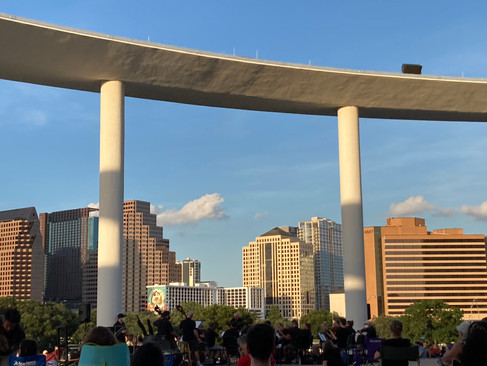
Grupo Fantasma / Austin, TX / June 12, 2021
Austin Symphony Orchestra Concert in the Park / Austin, TX / August 8, 2021
Comments